Course Link: Link
Official Course Link Visit the official link
Exam Pattern & Rules
Previous Paper
Videos
UGC Net
Overview:
The UGC NET Law examination, conducted by the National Testing Agency (NTA), is a crucial qualifying test for candidates aspiring to become university professors or pursue research careers in India.
To perform well, it is essential to have a clear understanding of the UGC NET Law Exam Pattern 2026. This guide focuses on the Law paper (Subject Code 41) and provides a structured overview to help you plan your preparation effectively. Let’s begin!
UGC NET Law 2026 – Examination Mode
The UGC NET Law 2026 examination will be conducted in Computer-Based Test (CBT) mode, ensuring a fast, secure, and efficient assessment process for candidates. Below is a detailed overview of the examination mode:
Computer-Based Test (CBT)
What It Means:
In this mode, candidates are required to take the examination on a computer. All questions are in multiple-choice (MCQ) format, and answers must be selected directly on the screen.
Advantages of CBT Mode:
- Speed and Efficiency: Responses are submitted instantly, allowing quicker evaluation and faster result processing.
- Ease of Use: Familiarity with computers helps reduce exam-related stress and improves performance.
- Accuracy: Eliminates manual checking errors and ensures precise recording of responses.
- Enhanced Security: Digital examinations minimise the risk of tampering and ensure safe handling of candidate data.
Detailed Pattern of UGC NET Law Exam 2026
1. Paper I: General Aptitude Test
Purpose:
As per the UGC NET Law Exam Pattern 2026, Paper I is designed to assess a candidate’s general aptitude for teaching and research. It evaluates analytical ability, comprehension skills, and overall awareness.
Key Topics Covered:
- Reasoning Ability: Tests logical and analytical thinking, including questions on sequences, series, and patterns.
- Reading Comprehension: Assesses the ability to understand and interpret written passages, followed by related questions.
- Divergent Thinking: Focuses on creative and innovative thinking through problem-solving based questions.
- General Awareness: Evaluates knowledge of current events and general facts, such as recent legal developments, constitutional amendments, and the current Chief Justice of India.
Question Pattern and Marking Scheme:
- The paper consists of 50 Multiple Choice Questions (MCQs).
- Each question carries 2 marks, making a total of 100 marks.
- All questions are compulsory, so candidates must prepare all sections thoroughly.
2. Paper II: Domain-Specific Test (Law)
Purpose:
According to the UGC NET Law Exam Pattern 2026, Paper II is designed to evaluate the candidate’s in-depth knowledge of their chosen subject, Law (Subject Code 41). This paper focuses on testing conceptual clarity and subject mastery.
Nature of the Test:
This paper reflects the core of your legal education. Questions are framed from various areas of law and may include landmark judgments, legal doctrines, principles, and detailed provisions of important statutes.
Question Pattern and Marking Scheme:
- The paper consists of 100 Multiple Choice Questions (MCQs).
- Each question carries 2 marks, making the total marks 200.
- The pattern is structured to thoroughly assess a candidate’s analytical ability, conceptual understanding, and application of legal knowledge.
How to Prepare for UGC NET Law Exam?
Step 1: Start Your Preparation Early – Build the Foundation for Success
Beginning your preparation for Andhra Pradesh Judiciary Exam well in advance is not just wise—it’s essential. Early starters gain a strategic edge that can make all the difference in a competitive exam like this.
Full Syllabus Mastery
Strong Conceptual Clarity
Reduced Stress & Burnout
Ample Time for Revision
Step 2: Stay Updated with the Latest Syllabus
https://www.linkinglaws.com/assets/pdf/contents/ugc-net-syllabus-linking-smart-arrangement-1145.pdf
Step 3: Select the Most Effective Books for UGC NET Law Exam Preparation
https://www.linkinglaws.com/publication
Step 4: Build a Smart & Flexible Study Plan
(a) Evaluate Your Current Knowledge Base
Begin by assessing where you stand. Take a few diagnostic tests or review past papers to identify your strong and weak areas. This self-assessment will guide your focus and help you prioritize subjects that need more attention.
(b) Set Achievable, Time-Bound Goals
Avoid cramming or unrealistic targets. Break the syllabus into manageable sections and assign weekly or monthly goals. This keeps your preparation focused and allows for steady progress without burnout.
(c) Allocate Time for Each Subject Strategically
Every subject deserves attention—especially the ones you find challenging. Customize your timetable to spend more hours on complex topics while maintaining regular touch with easier ones. Balance is key.
(d) Prioritize Regular Revision
Don’t wait until the last month to revise. Schedule revision slots throughout your plan to reinforce learning and improve retention. Revisiting topics multiple times helps solidify concepts and boosts confidence.
(e) Include Mock Tests & Performance Reviews
Mock tests simulate the real exam environment and help you identify gaps in preparation. Take them regularly, analyze your mistakes, and adjust your strategy accordingly. They’re not just practice—they’re progress checkpoints.
Pro Tip: Keep Your Plan Flexible
Life happens—unexpected events, fatigue, or even breakthroughs in understanding. Build buffer days into your schedule so you can adapt without losing momentum.
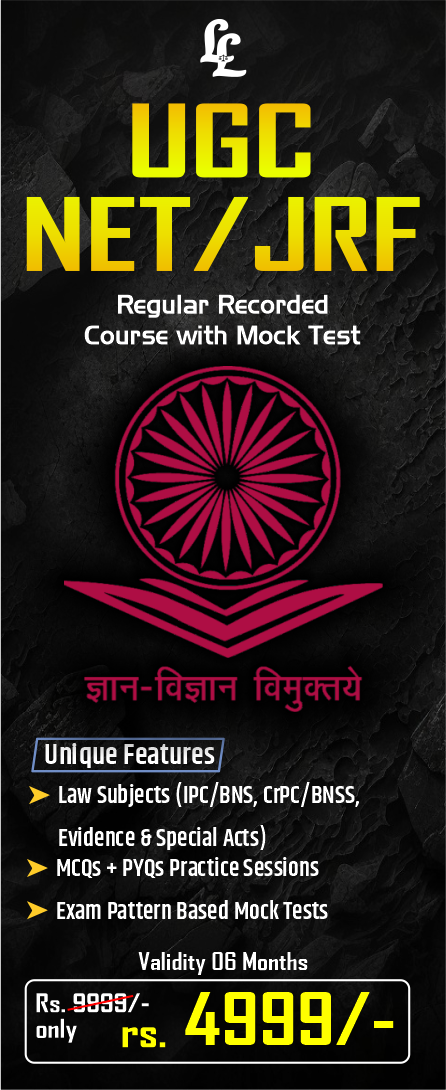
Step 5: Enroll in Expert-Led Assistant Prosecution Officer in UGC NET Course – Accelerate Your Preparation with Linking Laws
Joining a reputed coaching institute can significantly enhance your preparation for the UGC NET Law Exam Among the top choices, Linking Laws stands out for its innovative and result-oriented approach to legal education.
Added Value:
Designed to cater to aspirants from all walks of life Focus on conceptual clarity and practical application
Comprehensive Coverage: Linking Laws courses cover a wide range of topics, including Civil Procedure Code, Indian Penal Code, and other relevant laws including new criminal laws.
Interconnected Learning: The course helps students understand the relationships between different legal concepts and subjects, making it easier to grasp complex topics.
Diagrammatic Notes: Visual learning aids, such as diagrammatic notes, are used to help students understand and retain complex legal concepts.
Practice and Assessment: Some courses offer practice questions, assessments, and tests to help students evaluate their knowledge and track their progress.